Remote Work vs Work From Home: What’s the Difference?
Remote work and work from home are closely related, but they are not always the same thing. Work from home usually describes the place where someone performs their job: their residence. Remote work is a broader workplace arrangement in which work is performed away from a traditional employer worksite, subject to the employer's rules about where that work may take place.
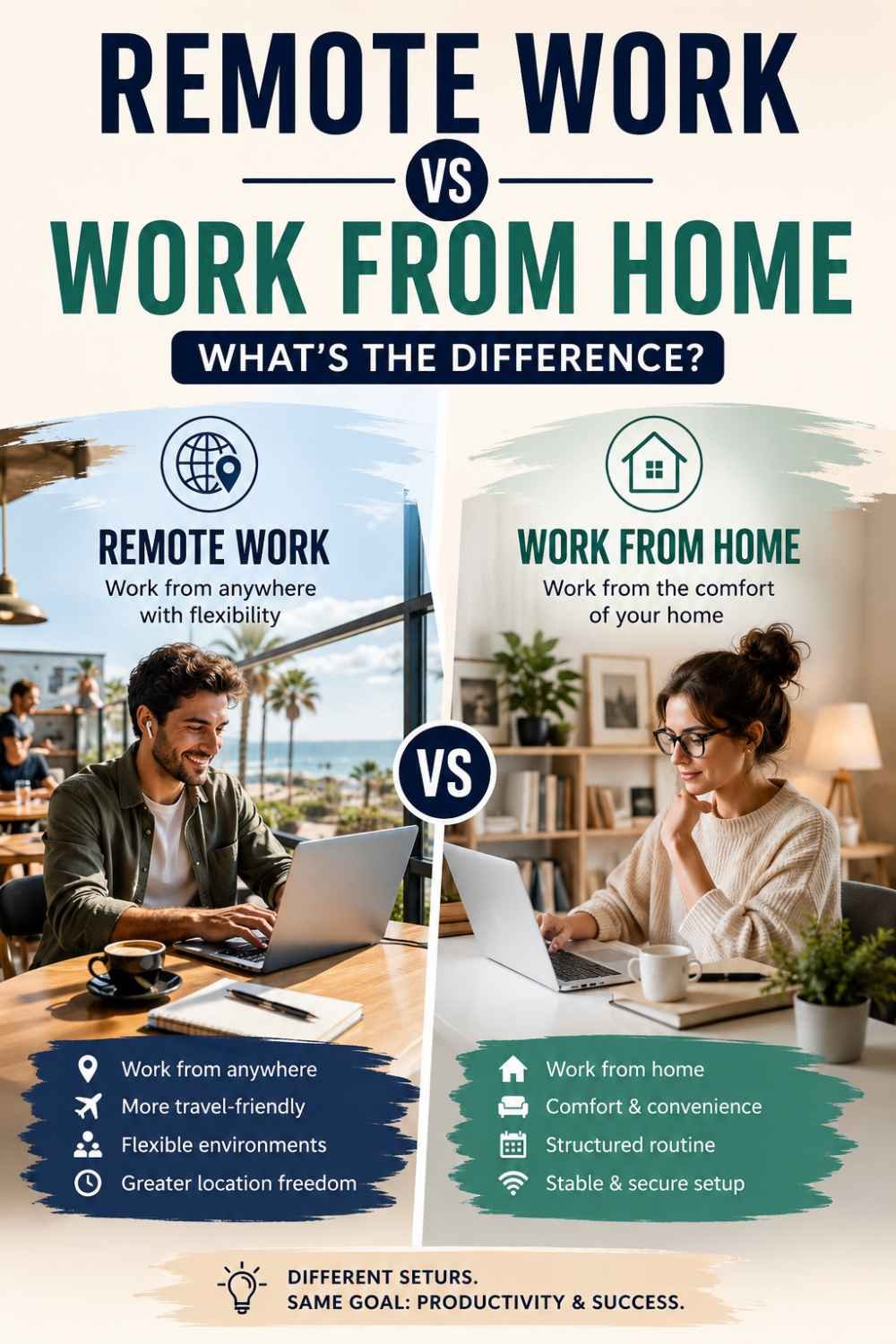
The phrases remote work and work from home, often shortened to WFH, are commonly used as if they mean exactly the same thing. In practice, they can overlap significantly without being identical.
A remote employee may spend every working day at home. At the same time, an office-based employee might work from home one or two days each week without holding a fully remote position.
The distinction becomes especially important when reading job listings. A position labeled "remote" may still require the employee to live in a particular state, country, region, time zone, or commuting area. Some organizations authorize only a designated home workspace, while others permit work from multiple approved locations.
What Is Remote Work?
In common workplace usage, remote work refers to an arrangement in which an employee performs normal job duties away from a traditional centralized workplace. The remote location might be the employee's home or another location authorized by the employer.
There is no single private-sector definition that every employer uses. The wording therefore needs to be interpreted in the context of the actual job and company policy.
The U.S. Office of Personnel Management provides a useful formal distinction for federal employment. OPM defines federal remote work as an arrangement in which an employee works at an alternative worksite under a written remote-work agreement and is not expected to perform work at an agency worksite on a regular and recurring basis. OPM distinguishes this from federal telework, which commonly includes regularly scheduled work both at an agency worksite and at an approved alternative location.
No Routine Office Schedule
A fully remote job generally means normal duties are performed away from a traditional company workplace. Occasional meetings, training, conferences, or other travel can still be required.
Remote Within Approved Areas
An employer may allow remote work only from selected states, countries, regions, or other approved locations. A remote job therefore does not necessarily provide unlimited geographic freedom.
What Does “Remote-First” Mean?
Remote-first is a workplace term rather than a standardized legal classification. It generally describes an organization that designs communication, documentation, meetings, and workflows so employees can participate effectively without depending on regular physical presence in a central office.
A remote-first employer may still operate offices, schedule company gatherings, or employ workers whose duties require occasional in-person attendance.
What Is a Distributed Team?
A distributed team consists of people working from different geographic locations. Employees may be spread across several cities, states, countries, or time zones. A distributed organization can be fully remote, remote-first, hybrid, or a combination of arrangements.
What Does Work From Home Mean?
Work from home means performing paid work from your residence. It describes the location of the work more directly than the overall structure of the job.
Someone may work from home under several different arrangements:
- Permanent WFH: The employee normally performs the job from home.
- Occasional WFH: An office-based employee works from home only when permitted.
- Scheduled WFH: The employee has designated home-working days and in-person days.
- Temporary WFH: The employee works from home for a limited period under an arrangement approved by the employer.
That means someone can work from home without being classified as a fully remote employee. An employee who works at home every Friday but reports to an office during the rest of the week is working from home on Friday, while the overall job may be hybrid or telework-based.
Remote Work vs Work From Home: Key Differences
The following comparison describes common usage rather than universal rules. Employers can define their own arrangements differently, so always check the actual job description and workplace policy.
| Factor | Remote Work | Work From Home |
|---|---|---|
| Main idea | A broader arrangement for performing work away from a traditional employer workplace. | Performing work specifically from the employee's residence. |
| Primary location | Home or another employer-approved location. | Usually the employee's home. |
| Location flexibility | Can be broad or tightly restricted depending on employer policy. | Generally centered on the approved home location. |
| Working while traveling | May be allowed, restricted, or prohibited. | Not automatically permitted merely because the employee normally works from home. |
| Coworking spaces | May be permitted if company security and workplace rules allow them. | May fall outside a home-based arrangement unless specifically approved. |
| Geographic eligibility | May be limited by state, country, region, time zone, or proximity to an office. | May be tied to a registered or approved residential work location. |
| Office attendance | Fully remote roles typically have no routine office schedule, although occasional attendance or travel may still occur. | A worker can have required office days if WFH is only part of a hybrid or telework arrangement. |
| Common listing terms | “Remote,” “fully remote,” “remote-first,” “U.S.-remote,” or “remote within selected states.” | “Work from home,” “WFH,” “home-based,” or sometimes “telework.” |
Four Simple Real-World Examples
These hypothetical examples show how two positions can both involve remote work while offering very different levels of flexibility.
Jordan has a fully remote position but must live and perform the work in Texas. Jordan does not routinely commute to an office, but the position is not location-independent.
Maya's residence is her approved work location. She works from home full time but needs authorization before performing her job somewhere else.
Leo works for a distributed organization that permits employees to work from several approved locations. His arrangement offers more geographic flexibility than a home-only setup.
Ana reports to an office three days each week and works from home on two designated days. She regularly works from home, but her overall arrangement is hybrid rather than fully remote.
Remote Work vs Hybrid Work
Hybrid work combines off-site work with scheduled or expected in-person work. For example, someone might work from home two days each week and report to an office during the other three.
A fully remote role generally does not include routine weekly office attendance, while a hybrid role does. That distinction can influence commuting time, housing choices, transportation expenses, relocation flexibility, and how close an employee needs to live to the workplace.
If you are evaluating both models, our detailed guide to remote jobs vs hybrid jobs explains the tradeoffs in greater depth.
Potential Benefits of Remote Work
Remote work can provide meaningful advantages, but none of these benefits should be assumed without checking the specific position.
Greater Potential Location Flexibility
Some remote positions allow employees to live farther from a corporate office or choose from multiple approved working locations.
Less Routine Commuting
Workers who are not required to report to an office regularly can avoid much or all of a conventional daily commute.
Broader Employer Access
Remote hiring can allow applicants to consider organizations located outside their immediate commuting area, provided the employer hires in the applicant's location.
Potential Schedule Flexibility
Some remote employers support flexible or asynchronous schedules. Remote status itself does not guarantee flexible working hours.
Challenges of Remote Work
Time-Zone Coordination
Distributed teams may need overlapping hours for meetings, customers, or collaboration even when employees work in different locations.
Digital Communication
Remote teams often rely heavily on written communication, video calls, shared documents, and project-management systems.
Location Restrictions
A job can be remote only within particular jurisdictions, limiting relocation or travel while working.
Security Requirements
Employers may require company devices, secure networks, VPNs, private workspaces, or restrictions on accessing sensitive information from public locations.
Potential Isolation
Some employees miss spontaneous workplace interaction and need to be more intentional about maintaining professional relationships.
Work-Life Boundaries
When work takes place at home, employees may need deliberate routines to separate working time from personal time.
Potential Benefits of Working From Home
A home-based arrangement can provide many practical advantages while keeping the employee in one predictable work environment.
- No normal office commute: Permanent home-based workers can usually begin and end the workday without traveling to a traditional office.
- Consistent workspace: Monitors, desks, chairs, headsets, and other equipment can remain set up in one place.
- Greater control over the environment: Depending on the household, a worker may have more control over noise, lighting, temperature, and interruptions.
- Potentially lower commuting expenses: Fewer trips to an office may reduce spending on fuel, fares, parking, or tolls.
- Predictable routine: Some people find it easier to establish a consistent working routine when they use the same home workspace each day.
Challenges of Working From Home
- Household noise or interruptions can affect concentration.
- Not every home has room for a dedicated workspace.
- Reliable internet can become essential to performing everyday duties.
- Employees may need to consider ergonomics, lighting, ventilation, and desk setup.
- Equipment, electricity, internet service, or furniture can create personal expenses when they are not provided or reimbursed.
- Some workers may experience less face-to-face social interaction.
- Having work and personal life in the same physical space can make boundaries harder to maintain.
Does Remote Mean You Can Work From Anywhere?
No. A remote job should never automatically be interpreted as permission to work from anywhere.
Employers frequently separate the question of whether a job requires office attendance from the question of where the employee is legally and operationally approved to perform the work. A job can therefore be fully remote while still being restricted to particular geographic areas.
Reasons for remote-job location restrictions can include:
- Payroll administration: Employing workers in another jurisdiction can create additional registration, withholding, reporting, or administrative obligations.
- Employment requirements: Workplace rules and employee protections can vary according to where work is performed.
- Tax considerations: Working across state or national borders can create tax questions for both workers and employers.
- Immigration and work authorization: Being permitted to visit another country does not necessarily mean a person is authorized to perform employment there. Rules depend on the destination and individual circumstances.
- Professional licensing: Some regulated occupations have jurisdiction-specific licensing requirements.
- Benefits and insurance administration: Employer obligations and coverage arrangements can vary by location.
- Information security: Organizations may restrict where systems or sensitive information can be accessed.
- Client requirements: Contracts can impose geographic, security, confidentiality, or data-handling restrictions.
- Time-zone coverage: Employers may require availability during designated business hours even when the position is remote.
How to Read a Remote Job Listing
Because remote-work terminology is not perfectly standardized, treat the label as a starting point. Look for details about location, office attendance, schedule, travel, and relocation.
| Phrase | What It Often Suggests | What to Confirm |
|---|---|---|
| Fully remote | No routine office schedule. | Eligible locations and whether occasional travel or meetings are required. |
| U.S.-remote | The employer allows remote work somewhere within the United States. | Whether applicants from every state are eligible. |
| Remote in selected states | Only specified states are approved. | Whether relocation after hiring is allowed. |
| Remote-first | Remote participation is a central part of company operations. | The exact requirements for the individual role. |
| Work from anywhere | Potentially broader geographic flexibility. | Country restrictions, duration limits, tax considerations, work authorization, security policies, and approved jurisdictions. |
| Home-based | The employee's residence is likely the primary work location. | Whether other locations are permitted. |
| Telework | Work is performed away from the traditional worksite for some portion of the schedule. | Required in-person days and approved alternative worksites. |
| Hybrid | Both remote and in-person work are expected. | How frequently office attendance is required and who controls the schedule. |
| Must live within X miles | The employer expects employees to remain within a defined distance of a workplace. | How often in-person attendance may be required. |
Questions to Ask Before Accepting a Remote Job
A few precise questions can tell you much more than the word “remote” in the job title.
- Which states, countries, cities, or regions am I permitted to work from?
- Is my home my designated work location, or can I use other approved places?
- Can I temporarily work from another state?
- Can I temporarily perform my job while outside the country?
- Are there required working hours or time-zone expectations?
- Will I ever be required to report to an office?
- Is business travel required?
- Does the employer provide a laptop, monitors, headset, or other equipment?
- Does the company reimburse internet or home-office expenses?
- Are coworking spaces or public Wi-Fi networks permitted?
- Are there VPN, privacy, data-handling, or physical workspace requirements?
- Do I need approval before relocating?
- Is the remote arrangement documented in the written offer or workplace policy?
- Under what circumstances can the employer change the remote-work arrangement?
Can You Get a Remote Job Without Experience?
Yes, some entry-level positions can be performed remotely. However, remote status does not eliminate the normal requirements of getting hired. Employers may still expect relevant skills, clear communication, reliability, organization, basic technical competence, and the ability to complete the responsibilities of the position.
Applicants who are beginning their careers can explore legitimate remote jobs with no experience while paying close attention to the qualifications and responsibilities listed for each opening.
Be cautious when a purported employer promises unusually high pay for minimal work, asks applicants to pay upfront for employment, sends unexpected checks to purchase equipment, requests sensitive financial information too early in the process, or cannot be verified through a legitimate company presence.
Finding Legitimate Work-From-Home Opportunities
When evaluating a home-based opportunity, focus on the employer and the responsibilities rather than being persuaded by the phrase “work from home.”
Verify the company's official website, look for the vacancy on its legitimate careers page when possible, review the actual duties, research the employer independently, and make sure the recruitment process resembles a normal professional hiring process.
If you specifically want a career that can be performed from home, our guide to the best work from home jobs compares occupations and the practical requirements involved.
Remote Work vs Work From Home: Which Is Better?
Neither arrangement is automatically better. The right choice depends on the work itself, the employer's rules, your home environment, and the type of flexibility you value.
Remote Work May Suit You If...
- You want access to employers outside your immediate commuting area.
- You value greater potential geographic flexibility.
- You are comfortable collaborating through digital tools.
- You can manage communication across locations or time zones.
- The employer's approved-location policy fits your plans.
Work From Home May Suit You If...
- You prefer a stable and predictable workspace.
- Your home provides an appropriate environment for focused work.
- You do not need to change locations frequently while working.
- You want to eliminate a routine office commute.
- You prefer keeping equipment in one consistent setup.
A Simple Decision Framework
Before comparing offers, examine five practical areas:
- Location: Where are you actually permitted to perform your job?
- Schedule: Are hours fixed, flexible, asynchronous, or tied to a particular time zone?
- Office requirements: Is in-person attendance ever required?
- Workspace: Do you have the privacy, internet connection, equipment, and physical setup required?
- Future flexibility: What happens if you relocate, travel, or the employer changes its workplace policy?
A position with less geographic freedom could still be the better opportunity if it provides the compensation, responsibilities, career path, management, benefits, and working environment you prefer. Someone who expects to relocate frequently may place much more value on a genuinely location-flexible arrangement.
Remote Work, WFH and Telework Are Not Perfectly Standardized Terms
One reason the terminology can be confusing is that employers, government agencies, researchers, and job platforms do not always use the same definitions.
For example, the U.S. Bureau of Labor Statistics Current Population Survey asks whether people “teleworked or worked at home for pay” during the survey reference week. BLS therefore uses a statistical measure that can include people who performed only some of their weekly work from home as well as people who performed all their work that way.
By contrast, the U.S. Office of Personnel Management uses specific definitions for federal remote work and telework. Private employers may use still different terminology.
Bottom Line
Work from home describes where you work, while remote work more broadly describes working away from a traditional centralized workplace. Actual location freedom depends on the employer's rules.
A remote employee may work entirely from home, from another approved location, or under a broader distributed-work arrangement. A person working from home may be fully remote, hybrid, temporarily home-based, or simply working from home on designated days.
The most important takeaway is simple: never assume “remote” means “work from anywhere.” Read the location requirements, ask specific questions, and understand the written policy before accepting an offer, relocating, or attempting to work while traveling.
Sources & Fact-Checking
This guide was reviewed against current authoritative U.S. sources. Workplace policies and legal requirements can change and can vary by employer and jurisdiction.
- U.S. Office of Personnel Management: Definition of Remote Work
- U.S. Office of Personnel Management: Definition of Telework
- U.S. Bureau of Labor Statistics: Telework or Work at Home for Pay
- Internal Revenue Service: Home Office Deduction Guidance
- U.S. Department of Labor: Telework, FLSA and FMLA Guidance
Fact-checked and reviewed: August 25, 2026