Applying for a remote job usually requires more than proving that you can perform the technical duties of the position. Depending on the role and employer, a hiring team may also want evidence that you can communicate clearly, organize your workload, meet deadlines, collaborate through digital tools, document important information, and handle routine problems appropriately.
That does not mean filling your resume with every remote-work phrase you can find. The most effective resume skills for remote work are the ones that match the position and that you can support with credible examples from your own work, education, projects, freelance assignments, or other relevant experience.
A financial analyst, customer support representative, developer, marketing specialist, and virtual assistant may all work remotely, but their strongest resumes should emphasize different qualifications. Remote work changes how some tasks are coordinated; it does not eliminate the underlying skills needed to perform the job.
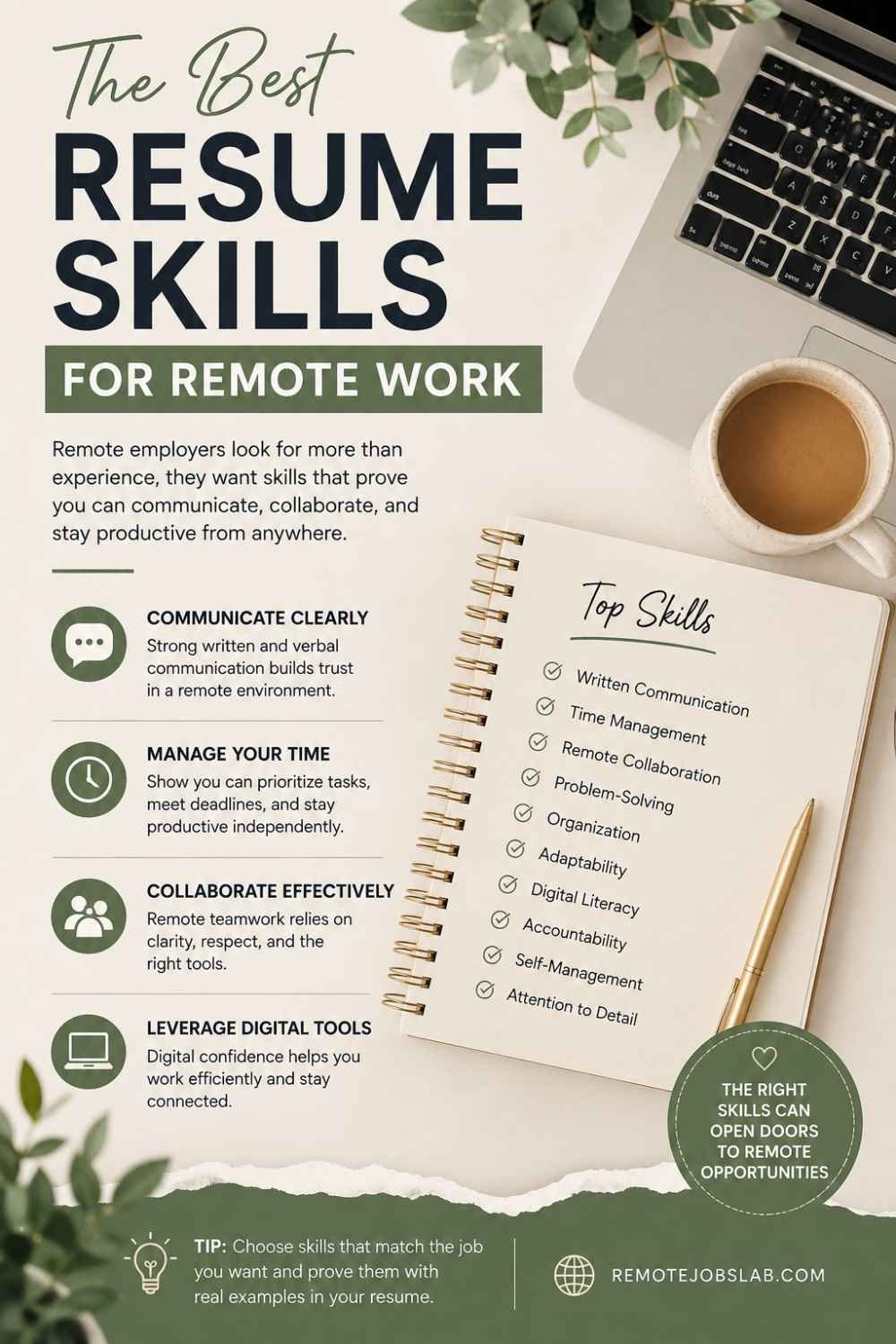
Good rule: start with the job itself, then add the communication, organization, collaboration, and self-management skills that are genuinely relevant to performing that job remotely.
What Makes a Skill Valuable for Remote Work?
Useful resume skills generally fall into three groups: job-specific technical capabilities, transferable professional skills, and abilities that become especially useful when coworkers are distributed across different locations.
Job-Specific Technical Skills
These are the abilities required to perform the occupation itself. An accountant may need financial reporting and spreadsheet skills. A software developer may need specific programming languages or development tools. A customer support specialist may need experience with ticketing systems, customer databases, and issue documentation.
These qualifications usually deserve significant attention because being remote does not replace the core requirements of the position.
Transferable Professional Skills
Transferable skills can apply across many occupations. Communication, organization, prioritization, analytical thinking, problem-solving, attention to detail, and project coordination are examples.
You do not necessarily need previous remote employment to demonstrate them. Someone who coordinated deadlines in an office, managed customers in retail, completed group projects at university, or organized volunteer work may already have experience that translates well to a remote environment.
Skills Particularly Useful in Remote Environments
Distributed teams often depend heavily on written updates, shared files, project-management systems, online meetings, digital workflows, documentation, and clear ownership of responsibilities. That can make skills such as asynchronous communication, digital collaboration, documentation, and self-management particularly useful.
Still, there is no universal list of skills for remote jobs. The actual job description should guide what you emphasize.
Best Resume Skills for Remote Work
The following abilities can be valuable across many remote positions. You should not list all of them automatically. Select the skills that fit the job and that you can genuinely demonstrate.
1. Written Communication
Useful for email, reports, project updates, customer messages, documentation, tickets, and shared workspaces.
2. Verbal Communication
Relevant to video meetings, client calls, presentations, training, interviews, sales conversations, and team discussions.
3. Time Management
Helps demonstrate that you can coordinate assignments, meetings, recurring work, and deadlines effectively.
4. Self-Management
Shows the ability to organize your workload, maintain focus, follow through, and recognize when help or escalation is needed.
5. Prioritization
Useful when several tasks or requests compete for attention and must be handled according to urgency and importance.
6. Digital Collaboration
Covers effective work through shared documents, project platforms, messaging systems, and online workflows.
7. Remote Teamwork
Includes keeping colleagues informed, meeting commitments, sharing context, and contributing reliably across locations.
8. Organization
Can include calendars, documents, records, files, tasks, follow-ups, schedules, and recurring responsibilities.
9. Problem-Solving
Demonstrates that you can investigate issues, use available resources, evaluate options, and escalate appropriately.
10. Adaptability
Useful when procedures, software, priorities, clients, responsibilities, or project requirements change.
11. Accountability
Means taking ownership of assigned work and communicating early when a risk could affect a commitment or deadline.
12. Independent Decision-Making
Relevant when employees are expected to make routine decisions within clearly established responsibilities and guidelines.
13. Digital Literacy
Shows comfort with the software, online systems, files, communication tools, and digital workflows required by the role.
14. Project Management
Includes coordinating deadlines, deliverables, dependencies, stakeholders, risks, approvals, and progress updates.
15. Calendar and Scheduling Management
Particularly relevant to assistants, recruiters, coordinators, sales teams, client services, and appointment-based roles.
16. Documentation
Useful for maintaining procedures, records, decisions, customer cases, project notes, reports, and reference materials.
17. Asynchronous Communication
Helps colleagues understand context, decisions, next actions, ownership, and deadlines without requiring simultaneous conversation.
18. Online Meeting Skills
Useful for people who facilitate meetings, train colleagues, present information, conduct interviews, or work directly with clients.
19. Attention to Detail
Especially relevant to finance, administration, editing, data, compliance, customer records, and quality-focused work.
20. Security Awareness
Includes responsibly handling company information and following an employer's approved security and privacy procedures.
How to Demonstrate Important Remote Work Skills
Written Communication
Remote teams may exchange information through email, messaging platforms, project comments, reports, customer tickets, shared documents, and internal knowledge bases. Clear writing helps coworkers understand what happened, what is needed, and what should happen next.
Resume example: Prepared weekly financial summaries for department managers, highlighting significant budget variances, outstanding issues, and required follow-up actions.
Time Management and Prioritization
These skills can be especially relevant when someone handles multiple deadlines or competing requests. Avoid simply describing yourself as good at time management. Show the responsibilities you successfully coordinated.
Resume example: Managed recurring monthly reporting deadlines while handling ad hoc analysis requests from multiple departments.
Self-Management
Self-management does not mean working without leadership or collaboration. Remote organizations can still provide supervision, feedback, teamwork, training, and structured processes. The skill is being able to manage assigned responsibilities without needing constant reminders.
Resume example: Maintained a recurring reporting calendar and followed up on missing departmental inputs before month-end deadlines.
Problem-Solving
Remote workers cannot always ask a nearby coworker for an immediate answer. Being able to investigate routine issues, use available information, and recognize when something should be escalated can therefore be valuable.
Resume example: Investigated recurring invoice discrepancies, identified inconsistent coding practices, and introduced a review checklist to improve processing consistency.
Digital Collaboration
Remote collaboration skills can include using shared documents, team messaging platforms, project boards, cloud workspaces, and other systems that allow several people to work together without sharing the same office.
Resume example: Coordinated campaign tasks across marketing and design teams using shared project boards, collaborative documents, and documented approval workflows.
Technical Skills for Remote Jobs
Your strongest technical skills should be determined by your occupation. A remote job is still fundamentally a job in accounting, customer service, software, marketing, administration, sales, data, or another field.
Accounting and Finance
- Financial reporting
- Financial analysis
- Budgeting and forecasting
- Account reconciliation
- Spreadsheet analysis
- Accounting or enterprise software relevant to the employer
Customer Support
- Customer relationship management systems
- Ticket management
- Written customer communication
- Issue documentation
- Escalation handling
Administrative and Virtual Assistant Work
- Calendar management
- Email management
- Scheduling
- Document preparation
- Spreadsheet management
- Online research
Marketing
- Content management
- Email marketing
- Campaign coordination
- Analytics
- SEO fundamentals
- Social media management
Sales
- CRM management
- Lead qualification
- Pipeline tracking
- Prospecting
- Sales presentations
- Account management
Software and IT
- Programming languages relevant to the position
- Version control
- Cloud platforms
- Technical troubleshooting
- Software testing
- Technical documentation
Writing and Content
- Research
- Writing and editing
- Content management systems
- Editorial planning
- SEO fundamentals
- Fact-checking
Project Management
- Project planning
- Task and milestone tracking
- Stakeholder communication
- Risk management
- Resource coordination
- Progress reporting
Data and Analytics
- Spreadsheet analysis
- SQL where relevant
- Data visualization
- Database querying
- Statistical analysis where required
- Reporting dashboards
Be accurate about proficiency. Do not list a platform simply because you have opened it once or watched a tutorial. Include software you can genuinely discuss and use at the level required by the position.
Soft Skills That Matter in Remote Work
Soft skills can be valuable, but vague claims are difficult for an employer to evaluate. Instead of asking the reader to believe an adjective, show the behavior behind it.
Weak: Excellent communicator.
Stronger: Prepared weekly project updates summarizing completed work, open decisions, risks, and upcoming deadlines for cross-functional stakeholders.
Weak: Highly organized.
Stronger: Maintained calendars, meeting records, follow-up actions, and recurring deadlines for three department leaders.
Weak: Great problem solver.
Stronger: Investigated recurring customer billing questions, identified common causes, and developed an internal troubleshooting guide for the support team.
The difference is evidence. A specific example tells a hiring manager considerably more than a broad personality claim.
How to Put Remote Work Skills on a Resume
Professional Summary
Your professional summary can establish the qualifications most relevant to the target role without becoming a generic list of personality traits.
Example: Financial analyst with experience in budgeting, monthly reporting, variance analysis, advanced Excel, and cross-functional collaboration. Skilled in managing recurring deadlines, documenting findings, and communicating financial results to non-finance stakeholders.
Dedicated Skills Section
A skills section is useful for technical capabilities, software knowledge, and concise professional competencies that directly support the position. Avoid turning it into a long inventory of everything you have ever done.
Work Experience
This is often the most convincing place to demonstrate remote work skills because an experience bullet can show the skill in context.
Whenever possible, describe the responsibility, action, scope, improvement, or outcome rather than simply repeating terms from your skills section.
Projects
Projects can be especially useful for career changers, recent graduates, freelancers, and applicants with limited formal experience. A real online project may demonstrate research, planning, communication, organization, or technical ability even when it was not part of a traditional remote job.
Certifications and Training
Relevant certifications can support your qualifications when they relate directly to the position. A certificate, however, should not be used to imply a level of practical competence you do not actually possess.
Remote Resume Examples: Weak vs. Strong
Communication and Time Management
Weak: Good at communication and time management.
Better: Coordinated weekly deliverables across a distributed five-person team while maintaining project deadlines through documented status updates and shared project-management tools.
Customer Support
Weak: Excellent customer service skills.
Better: Resolved customer questions through email and support tickets, documented account issues, and escalated cases requiring specialized assistance.
Finance
Weak: Strong Excel and analytical skills.
Better: Built and maintained spreadsheet-based monthly reporting schedules used to analyze departmental spending and investigate significant budget variances.
Administration
Weak: Organized virtual assistant.
Better: Managed calendars, meeting schedules, follow-up tasks, shared documents, and recurring administrative deadlines for multiple stakeholders.
Marketing
Weak: Team player with marketing experience.
Better: Coordinated campaign deliverables with writers and designers, tracked approvals, and maintained shared content schedules across concurrent projects.
What If You Have Never Worked Remotely?
You do not need to pretend that previous employment was remote when it was not. Instead, identify situations in which you already demonstrated abilities that transfer well to remote work.
Relevant evidence can come from:
- office jobs;
- freelance assignments;
- college or university projects;
- internships;
- volunteer work;
- independent projects;
- online collaboration;
- customer-facing work;
- responsibilities requiring independent planning and follow-through.
For example, someone who managed multiple deadlines independently in an office has already demonstrated time-management skills. A student who coordinated a group presentation using shared documents has experience with digital collaboration. A retail employee who handled customer complaints can demonstrate communication, judgment, and problem-solving.
The important point is to describe the experience accurately rather than presenting it as something it was not.
If you are beginning your search without previous remote employment, our guide to Best Remote Jobs With No Experience explores positions and career paths where transferable skills and entry-level qualifications may be especially useful.
Skills for Higher-Paying Remote Roles
General remote work skills can strengthen an application, but specialized positions usually depend heavily on occupational expertise.
A senior financial professional may need advanced analysis, modeling, or reporting capabilities. A software engineer may need expertise in particular technologies. A cybersecurity role may require specialized technical knowledge. A senior marketing position may require demonstrated experience in strategy, analytics, campaign management, or other advanced responsibilities.
Communication, organization, collaboration, and self-management remain useful, but they rarely replace the core expertise required for a specialized role.
If you are exploring career paths that may offer greater responsibility and earning potential, the Remote Jobs Lab guide to Highest-Paying Remote Jobs can help you compare several professional directions worth researching.
Remote Resume Skills to Avoid
Unsupported Buzzwords
Terms such as “results-driven,” “dynamic,” “self-starter,” and “excellent communicator” provide limited information by themselves. Whenever possible, replace broad adjectives with evidence.
Software You Cannot Actually Use
Do not add tools simply because they appear in a job advertisement. If an interviewer asks you to describe your experience with a platform, an exaggerated claim can quickly weaken your credibility.
Basic Abilities That Add Little Value
Depending on the occupation, listing basic activities such as sending email or joining video calls may not distinguish you from other candidates. Use limited resume space for qualifications that meaningfully support your suitability for the role.
Every Keyword From the Job Description
A job description is a useful guide, not text to copy into your resume. Use relevant terminology when it accurately describes your abilities, experience, and qualifications.
Exaggerated Remote Experience
Do not describe occasional work-from-home days as extensive remote employment. Present your background honestly and emphasize the transferable abilities that genuinely support remote work.
Personality Traits Without Proof
Words such as “reliable,” “motivated,” and “hardworking” are difficult to evaluate on their own. Your accomplishments, responsibilities, and employment history can provide stronger evidence.
How to Choose Skills From a Remote Job Description
- Read the entire job description. Do not rely only on the job title or introductory paragraph.
- Identify job-specific requirements. Look for technical knowledge, responsibilities, software, credentials, and experience.
- Notice repeated competencies. If communication, reporting, client management, collaboration, or project ownership appears several times, it may be important to the employer.
- Separate required and preferred qualifications. They are not necessarily weighted equally.
- Compare the requirements with your real experience. Do not claim skills you cannot support.
- Prioritize your strongest relevant matches. Put the most useful qualifications where they are easy to find.
- Demonstrate important skills through accomplishments. Where possible, show what you did rather than repeating the wording of the advertisement.
Applicant tracking systems and recruiting platforms vary in how they store, search, rank, or present applicant information. Relevant terminology can make your qualifications easier to identify in some hiring workflows, but there is no single keyword formula that guarantees an interview or guarantees that a resume will “pass” every ATS.
A sensible approach is to use clear formatting and describe genuine skills and experience using terminology that naturally corresponds with the position. Keyword stuffing or copying an advertisement is not a substitute for relevant qualifications.
Example Remote Resume Skills Section
A finance professional might use:
A customer support professional might use:
A marketing applicant might use:
The point is not to create one universal collection of work from home resume skills. The skills section should change when the target job changes.
Remote Resume Checklist
Before submitting a remote job application, give your resume one final review.
- Are my strongest skills directly relevant to this specific position?
- Can I provide credible evidence for every important skill I claim?
- Are job-specific technical capabilities easy to find?
- Do my experience bullets demonstrate communication, organization, and ownership where relevant?
- Have I shown examples instead of relying on vague personality traits?
- Have I removed software or skills I cannot confidently discuss?
- Have I avoided copying large sections of the job description?
- Is my resume organized, readable, and easy to scan?
- Are job titles, dates, numbers, company names, and contact details accurate?
- Have I proofread the final document carefully?
Final Thoughts
The strongest remote work resume is not the one with the longest list of skills. It is the one that makes a credible connection between what the employer needs and what you can genuinely do.
Start with the requirements of the position. Prioritize the technical abilities needed to perform the job, then reinforce them with relevant strengths such as communication, digital collaboration, organization, problem-solving, documentation, time management, and accountability.
Most importantly, demonstrate important skills through real examples whenever possible. A clear accomplishment or responsibility usually tells an employer more than another unsupported adjective in a skills section.